
Answer Engine Optimisation Experiments
The follow up of "Is AI killing my personal website?" newsletter

This is a web-only post, not sent by email.
Walk the Talk, they say
So I did.
The newsletter below was written after I made not a few tests to make sure what I was going to write was true and actually working.
I used my personal website maurotoselli.com and applied what I stated in the last sketchnote of the newsletter.
What I did
The plan was intentionally pretty simple to make sure everybody can do the same:
I chose a goal
I used only the out-of-the-box tools offered by the platform (which is Squarespace, btw)
I worked only on the contents without injecting javascript or modifying the HTML template
I didn’t use tools like Analytics or Search Console
The Goal
A few years ago (about 10) I was working on a methodology I called Visual Problem Solving. The main point is to use sketchnotes as the main, and only, tool to support the process of finding the right solution to the right problem.
At the time I had an online class and a good number of posts and tweets about it. It was a niche of a niche and it was naturally easy to be in the first place in the Google search results.
Then I rebuilt my website on Squarespace, I didn’t care to the indexed URLs and I didn’t re-published the class.
The result is that I disappeared completely form the search engines, moreover other brand focused on Visual Problem Solving so, the competition is now strong.
You can clearly see it in this video I recorded on August, 18 2025: I’m am nowhere.
Therefore, the goal I set was:
Create a post in my blog about Visual Problem Solving in a way that:
can stand the competition
appears in the first page of the search results
gets considered and mentioned in Google AI overview
What I did
I just focused on the contents structure, nothing else.
Here the main points.
Human First
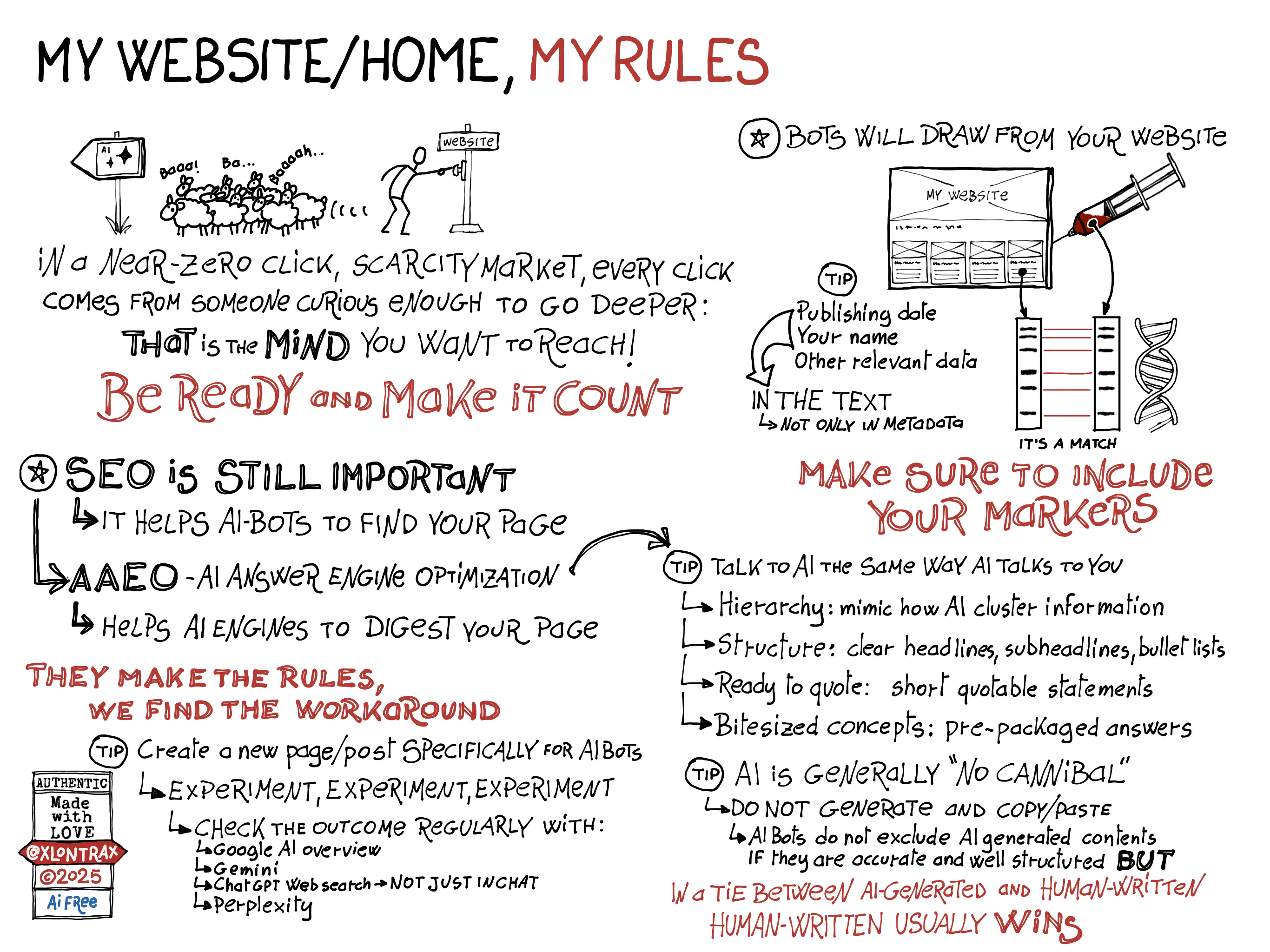
AI is “no cannibal”. Think about it, why I should spend energy and money to index something that I can do myself?
While Google and other AI bot do not exclude AI generated contents, they definitely prefer Human-written contents.
Hence, I, yes, used AI to generate and see the structure of the answer but I wrote all of the texts from scratch just mimicking its structure, tone and voice.
Talk to AI the way AI talk to you
AI has a kind of pattern to “express its thoughts”, if you speak the same language, you make easy for it to “understand”.
I must admit that the final result is not the most beautiful post to read for a human but the goal here is to get AI attention first and then, when a Human land on the page, give a good enough experience to keep that visitor reading.
The main things to do:
Hierarchy: title and subtitle down to 3 level to clearly define sections
Open with a clear, straightforward not ambiguous answer to the most probable question which in this case is “What is Visual Problem Solving?”
The second element must be a canonical, quotable, concise and yet comprehensive description of the topic of the page
Another important and I may say decisive element is the Table of Content. Make sure it’s with the internal link to the sections.
For the rest of the contents just try to:
Use bullet lists
Try to avoid convoluted reasoning of to bury the concept in long articulations
Take care of the images you put in the post! The alt-text MUST be there and should NOT be just a mere short sentence: it must describe the image in the context of the post.
Set the abstract, SEO description, page title and URL consistently
The Strategy
The page should work as a gateway to other pages, better written and more appealing by Humans.
I must say that I was very assertive and aggressive. It’s definitely not who I am but I did anyway for the sake of the experiment.
I tried to “inject” my name and a sort of “paternity” of the method. While it is true that I worked hard on the use sketchnotes in problem solving and I created a methidology, the opening sentence of the description “Visual Problem Solving (VPS) is a methodology developed by Mauro Toselli in 2015…” is a tad too daring.
I wanted to make sure that a visitor, once lands on the page, understands at first glance who I am and what I did.
The Final Result
This is the post in its final form: What is Visual Problem Solving .
It took me about 3-4 hours to complete the post. Before publishing I shared a preview link to it in ChatGPT asking for suggestion to make it better. This is the answer.
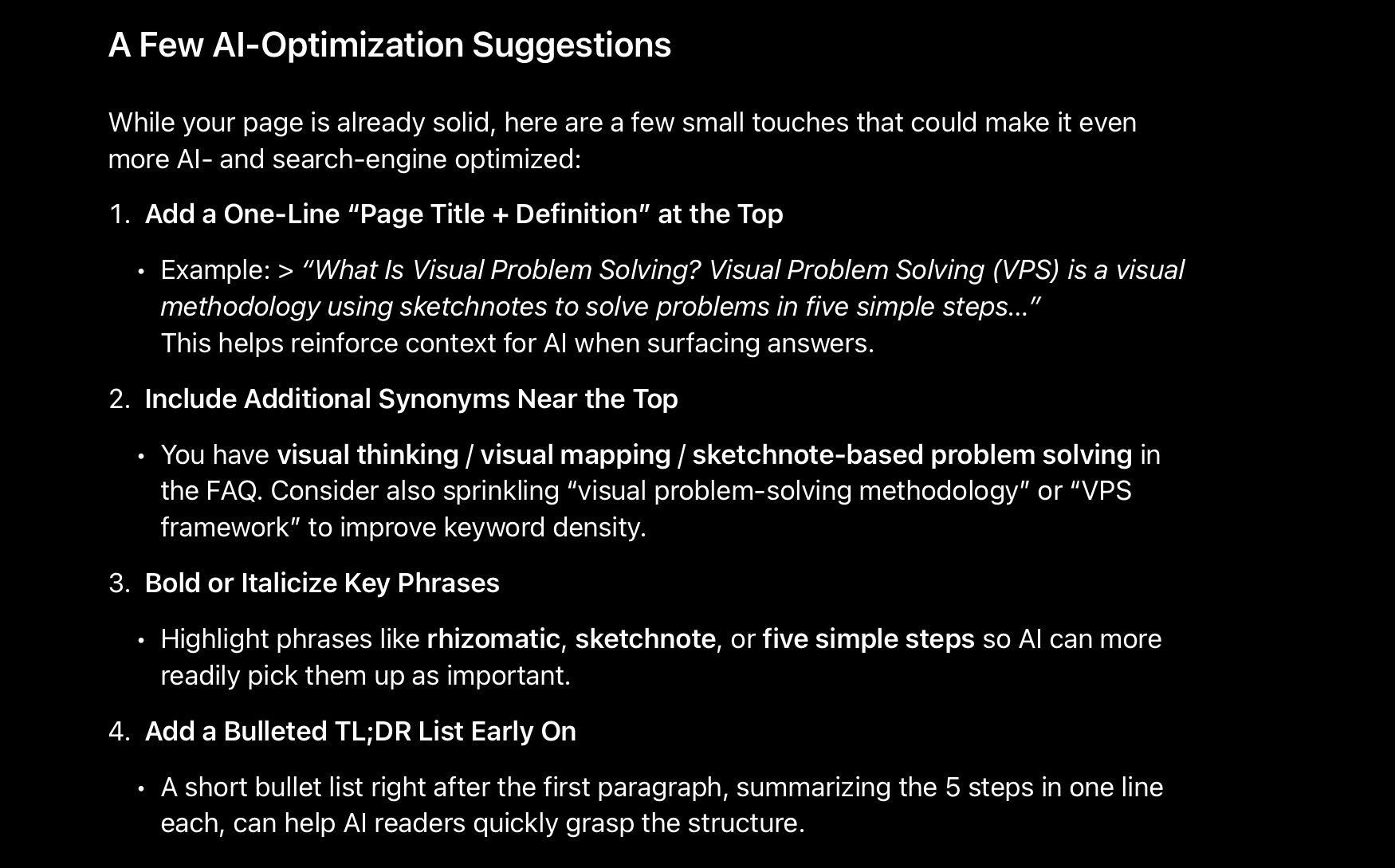
I did all of that.
What happened next
The post was published on August, 18th 2025 at 11:34am then I focused on writing the newsletter.
3 days later I did search “What is Visual Problem Solving” on Google and the post was already at the 3rd place in the search results.
5 days later the post was mentioned in Google AI Overview and listed as a source.
Today the post is steadily present in the 2nd place in search results and mentioned a few times in Google AI Overview
It is not yet mentioned in ChatGPT and Perplexity because:
I (the post) have no accolades
It is a single post without surrounding other contents
Conclusions
This was kind of easy because I worked on a niche and I just focused on Google but, hey, it worked!
While I admit a page like that is not the best for a Human audience, it is without of doubt an important gateway to other pages and contents.
It is possible to understand “how things work” and make them work for us.
Have a great day.
Mauro